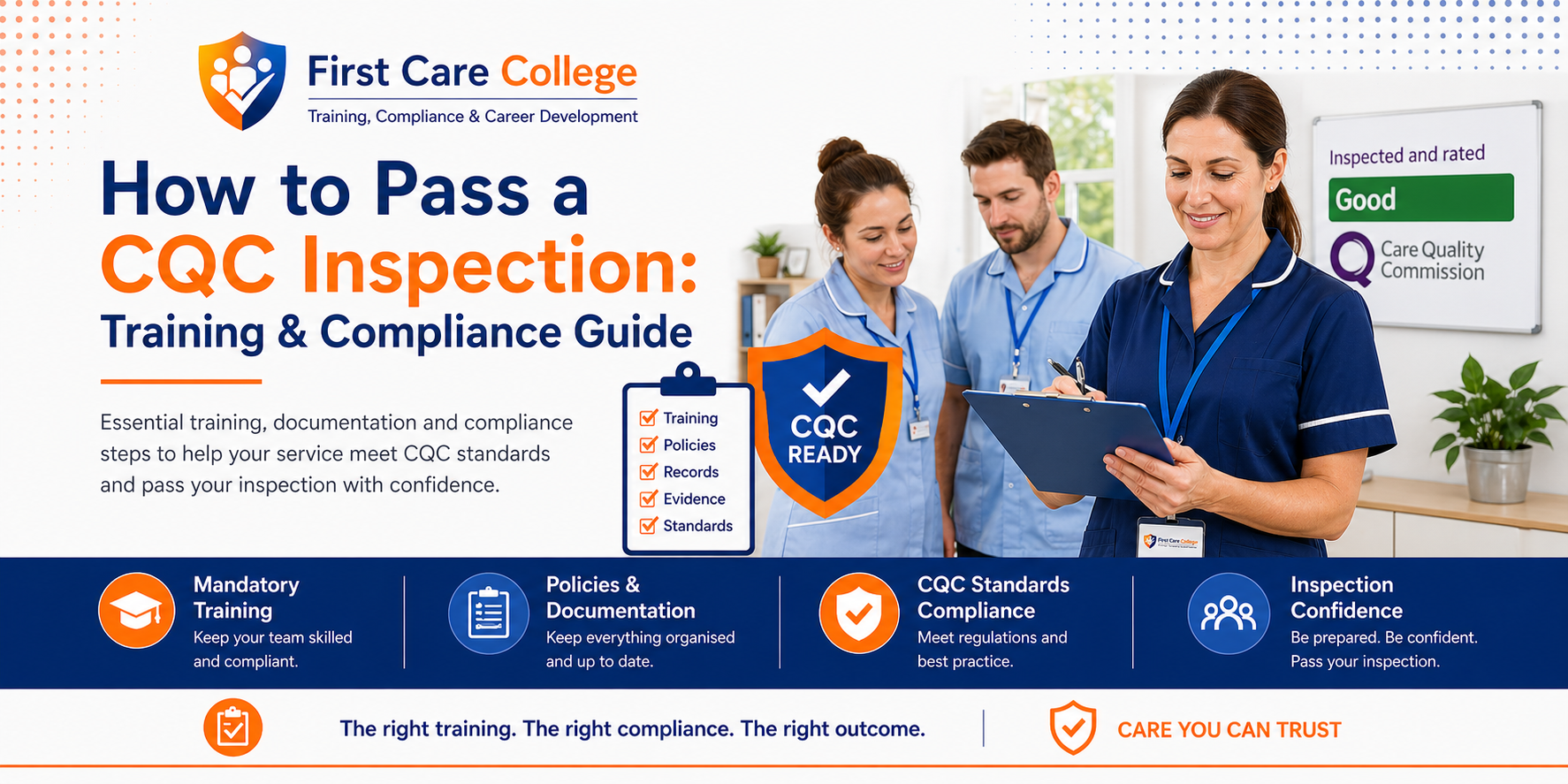
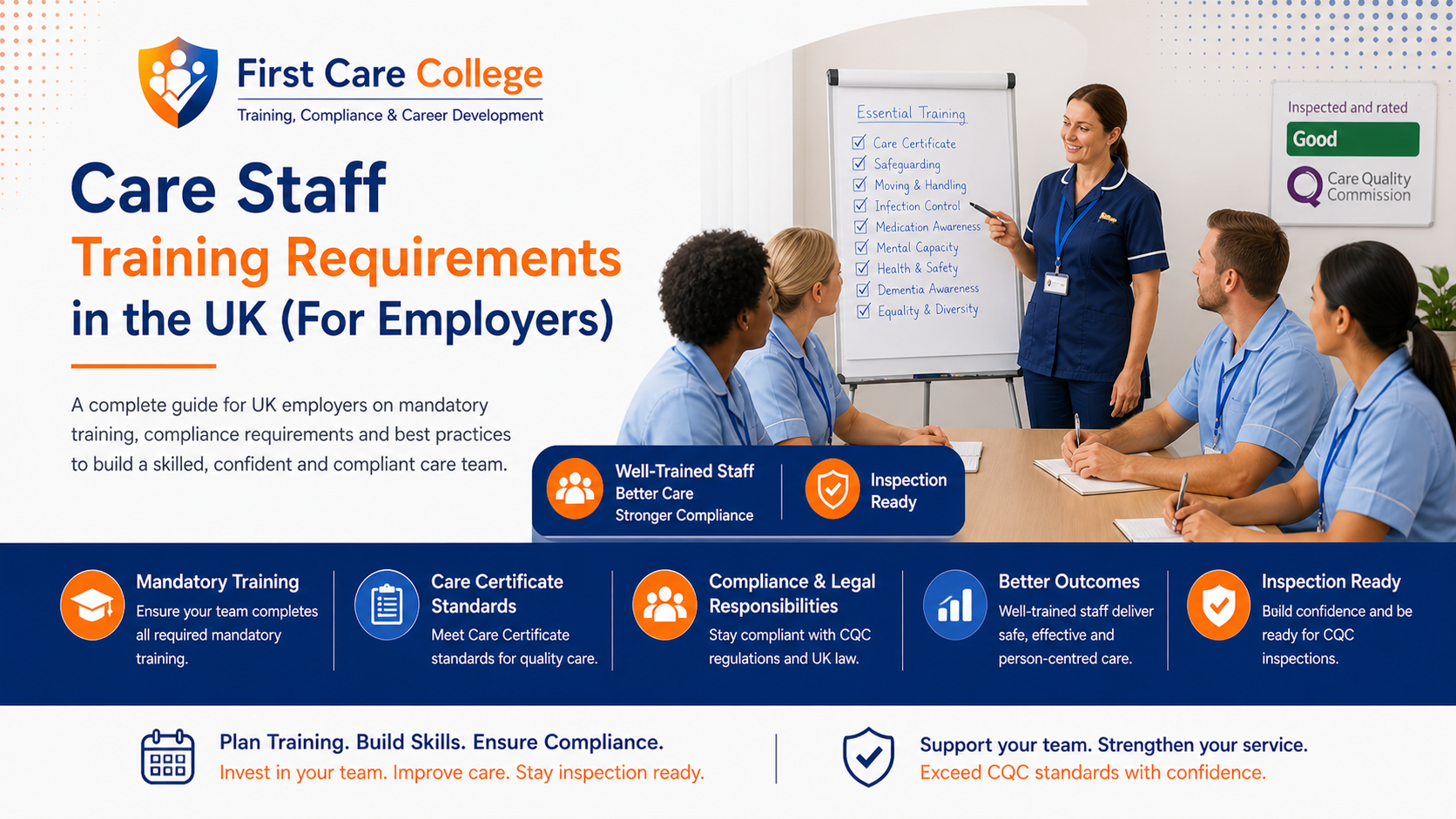
Every week, care homes across the UK face CQC inspections that reveal the same uncomfortable truth: the most common reason a service falls short is not a lack of compassion, it is a lack of properly structured staff training.
For care home owners, registered managers, and employers in the adult social care sector, this is something most providers cannot afford to ignore anymore.
Care staff training requirements in the UK have never been more clearly defined, and yet compliance failures remain one of the leading causes of poor inspection outcomes.
Whether you are onboarding a new team member, renewing mandatory training, or preparing for your next CQC visit, understanding your obligations as an employer is not optional. It often determines whether your service stays compliant or starts facing regulatory pressure.
This guide covers everything you need to know to stay compliant, protect your team, and deliver outstanding care.
Why Care Staff Training in the UK Matters More Than Ever?
The adult social care sector in England alone employs around 1.52 million people, according to Skills for Care. Staff turnover remains high at approximately 28.3%, which means a significant proportion of your workforce at any given time may be relatively new to their role.
That makes structured, consistent training not just important but essential if you want to stay compliant and avoid gaps.
The CQC assesses providers against five key questions: Are services safe, effective, caring, responsive, and well-led?
Training sits at the heart of at least three of these. Inspectors look specifically at whether staff have received appropriate training to carry out their roles and whether they are competent to do so. A lack of documented, up-to-date training can quickly push your rating in the wrong direction.
Legal Responsibilities of Employers in Health and Social Care in the UK
As an employer in the UK care sector, the responsibility for ensuring your staff are trained and competent sits firmly with you. That might sound straightforward, but in practice, many providers underestimate just how detailed this obligation is.
Under the Health and Social Care Act 2008 (Regulated Activities) Regulations 2014, you are legally required to ensure that all staff receive:
- Appropriate training relevant to their role
- Regular supervision and appraisal
- Ongoing support for learning and development
The CQC takes this seriously during every inspection. Inspectors will look for evidence that:
- Staff hold the right qualifications, skills, and experience for their role
- A clear system for ongoing learning and development is in place
- Training records are accurate, current, and readily accessible
Falling short on any of these is not just a paperwork issue. It can result in formal warnings, enforcement action, or in the most serious cases, service closure.
Getting your training obligations right from the start is always far easier than trying to fix them under regulatory pressure.
Mandatory Training Requirements for Care Staff in The UK
Understanding mandatory training for care staff in the UK is important for building a compliant, confident workforce. Requirements can vary for each role and settings, but there are areas that must be covered without exception.
1. Induction Training
Every new staff member should complete a structured induction before working independently. A solid induction typically covers:
- Your organisation’s policies and procedures
- An introduction to safeguarding and duty of care
- Basic health and safety awareness
- Roles, responsibilities, and reporting structures
Most providers follow the Care Certificate as part of this process. It is not a legal requirement in the strictest sense, but it is widely recognised across the sector and expected by the CQC as evidence of foundational competence.
2. Core Mandatory Training Topics
These are the subjects that form the backbone of health and social care training in the UK. Regardless of role or seniority, the following are considered essential for most care staff:
- Safeguarding adults and vulnerable individuals
- Infection prevention and control
- Moving and handling
- Health and safety awareness
- Fire safety
- First aid awareness
- Medication handling basics
Inspectors will look for evidence that your team has completed these. Gaps here are one of the quickest routes to a poor CQC outcome.
3. Role-Based Training Requirements
Not every member of staff needs identical training. What matters is that training reflects the actual responsibilities of each role.
3.1. Care Assistants
- Personal care techniques
- Dementia awareness
- Communication and person-centred care skills
3.2. Nurses
- Clinical competencies relevant to the setting
- Medication administration and management
- Advanced care procedures
3.3. Managers and Supervisors
- Leadership and people management
- CQC compliance and governance
- Risk assessment and auditing
Getting this right shows inspectors that your training system is thoughtful and intentional, not just a generic checklist applied to everyone.
4. Ongoing and Refresher Training
Training is not a one-time activity, and treating it as such is one of the most common compliance mistakes in the sector. Regular refreshers are essential, and most mandatory topics require annual renewal.
Some may vary depending on your internal policies or the risk level associated with a particular role.
Keeping training records current and renewal dates visible is what separates a reactive training system from one that genuinely protects your service.
Strong care home staff compliance training is built on consistency, not catch-up.
Are you looking for a trusted training provider to keep your team compliant?
First Care College offers accredited, CQC-aligned training courses designed specifically for the UK care sector. You can explore their full range of mandatory care training courses to find the right fit for your team.
Statutory vs Mandatory Training
This is one of the most common points of confusion for employers, so it is worth taking a moment to clarify the difference.
1. Statutory training
It refers to training that is required by law. This includes fire safety training, health and safety training and moving and handling training. If you are not providing statutory training, you are breaking the law, full stop.
2. Mandatory training
It refers to training that your organisation, a regulatory body, a commissioner, or a professional standards body requires. It may not always be directly imposed by legislation, but it is expected as a condition of registration, funding, or best practice compliance.
In short, all statutory training is mandatory, but not all mandatory training is statutory. Both carry real consequences if neglected.
What Are The Risks of Non-Compliance?
Ignoring or neglecting training requirements can have serious consequences, and in a sector built on trust, the damage can be swift and lasting.
1. CQC Inspection Failures
Inspectors do not just look at how care is delivered on the day. They might ask you to present training records as well. Incomplete or outdated documentation can drag your rating down even when your team is doing their best on the floor.
2. Legal and Financial Consequences
If you are non-compliant, you may not just face regulatory inconvenience, but it can lead to serious consequences. It may result in enforcement notices, financial penalties, or even legal action against you as the registered provider.
3. Poor Care Outcomes
It is not necessary that untrained staff will be bad. But without the right knowledge or skills, even the most caring person can make mistakes that can put innocent individuals at serious risk. So it is always mandatory to have proper training.
4. Reputation Damage
A poor inspection report does not stay behind closed doors. Families read them, commissioners reference them, and occupancy levels often reflect them. Rebuilding trust after a public failure takes far longer than maintaining compliance in the first place.
This is why CQC training requirements should never be treated as an afterthought. The stakes are simply too high.
How to Stay Compliant with Training Requirements?
Staying on top of statutory and mandatory training in the UK care sector requires a structured, ongoing approach. Here are the steps that make the biggest difference.
1. Build and maintain a training matrix
A training matrix gives you a real-time view of every staff member’s training status. It should list every required subject, the date each member of staff last completed it, and when renewal is due. Review it monthly.
2. Assign clear responsibility
Someone in your organisation, whether that is a training coordinator, a deputy manager, or yourself, must own the training compliance process. Shared responsibility often means no responsibility.
3. Use a combination of delivery methods
Some training, such as e-learning modules on information governance, translates well to online platforms. Other training, particularly moving and handling and basic life support, must include a face-to-face, practical component to be valid.
4. Include all categories of staff
Agency workers, bank staff, and volunteers must be included in your training oversight. Do not assume their agencies have covered everything your service requires.
5. Keep records that are inspection-ready
The CQC will ask to see evidence of training. This means signed attendance records, completion certificates, and competency assessment sign-offs, all stored in a format that can be retrieved quickly.
6. Review training content regularly
Legislation, guidance, and best practice evolve. Your training content needs to keep pace. Review all materials at least annually and update them whenever there is a significant change in regulation or local authority requirements.
Struggling to Keep Up with Staff Training and CQC Expectations?
If you are constantly chasing training records before inspections, worrying about expired certificates, or unsure whether your team is fully compliant, you are not alone. Instead of trying to manage everything manually, having the right training partner can take a huge load off your shoulders.
First Care College supports care providers across the UK with practical, CQC-focused training that actually fits into your day-to-day operations. It helps you stay organised, keep your team up to date, and walk into inspections with confidence rather than stress.
If you still have doubts, you can get in touch with the team directly.
Conclusion
Training is the single most powerful lever you have as a care employer. It protects the people in your care, protects your staff, protects your business, and underpins every outcome the CQC measures.
Meeting health and social care training requirements in the UK is not a one-off task; it is an ongoing commitment that sits at the centre of good governance.
The employers who get it right are the ones who treat training as a continuous process rather than a reactive one. They know their training matrix inside out, they invest in their people, and they never wait for an inspection to reveal a gap.
If you are unsure where your current training programme stands, now is the right time to find out. Because in social care, the cost of not knowing is always higher than the cost of getting it right.
Start your training today with First Care College!