Last year, a care home in Birmingham was handed an Inadequate rating by the CQC. Not because the staff did not care. Not because the residents were unhappy. But because training records were incomplete, refresh cycles had been missed, and the manager could not explain the difference between what the law required and what their own policies demanded.
That one knowledge gap cost them everything. If you manage a care home in the UK right now, this is not a distant cautionary tale.
According to Skills for Care, only 51% of care workers in England hold a relevant care qualification. Meanwhile, CQC inspection reports consistently flag poor training as a primary driver of unsafe care.
Understanding the difference between mandatory and statutory training is not a bureaucratic exercise. It is the single most important compliance decision you will make for your residents, your staff, and your registration.
What Is Mandatory Training in Care Homes?
Mandatory training for carers in the UK refers to training that your organisation requires every staff member to complete. It is not always prescribed by legislation, but your duty of care, your internal policies, and your residents’ specific needs make it completely non-negotiable within your setting.
Here is something most training guides will not tell you: Two care homes can sit on the same street, serve similar residents, and have entirely different mandatory training lists. That is because mandatory training is shaped by your environment, your risk profile, and the people in your care.
A home supporting residents with Parkinson’s disease, for example, would rightly treat dysphagia awareness as mandatory training for carers in the UK context. No single law demands it by name.
But your professional responsibility and your residents’ safety absolutely do.
Why Mandatory Training Matters for CQC Inspections?
CQC mandatory training expectations are embedded across the inspection framework. Under the Effective and Well-led key questions, inspectors examine whether staff have the right skills, knowledge, and support to do their jobs properly.
If your training matrix is vague, inconsistent, or poorly evidenced, that will show up in your rating.
Here is a figure worth remembering: The CQC’s State of Care 2022 to 2023 report found that workforce issues, including inadequate training, featured in the majority of services rated Inadequate or Requires Improvement. That is not a coincidence but a pattern.
When a safeguarding incident occurs and solicitors or investigators start examining your records, the first document they request is your training matrix.
If your own policies stated a course was required and a staff member had not completed it, you have handed them the evidence they need against you.
Common Mandatory Training Courses for Carers in the UK
Most care home providers include the following within their mandatory training for carers in the UK:
- Manual handling and moving people
- Basic life support and CPR
- Safeguarding adults and children
- Infection prevention and control
- Medication awareness and safe administration
- Fire safety awareness
- Food hygiene and nutrition
- Equality, diversity, and inclusion
- Mental health and dementia awareness
- Lone working and personal safety
Your list should never be a generic copy-paste from a template. It must reflect your service type, your residents’ needs, and your most recent risk assessments. Review it at least annually and update it when your resident profile changes.
If you are struggling to decide which mandatory courses your team actually needs, First Care College offers role based training bundles that remove the guesswork and save valuable time.
What Is Statutory Training in Care Homes?
Statutory training is a completely different legal category. This is training that UK legislation, statutory regulation, or government guidance specifically requires. There is no employer discretion here.
If the law demands it, then you must deliver it.
The legal sources behind statutory training in the UK care sector are not just one document. They come from multiple frameworks that sit at the core of how care services are regulated, including:
- The Health and Safety at Work Act 1974, which places a direct duty on you as an employer to ensure staff are trained to work safely
- The Care Act 2014, which establishes clear safeguarding responsibilities
- The Health and Social Care Act 2008, which underpins your entire CQC registration and inspection framework
When any of these frameworks demand specific training, failing to deliver it is not a performance gap. It is a legal breach with real consequences.
Legal Importance of Statutory Training in UK Care Settings
In 2023, a registered care provider in the East Midlands had their registration cancelled following repeated failures identified during CQC inspection.
Among the cited reasons were systematic gaps in fire safety training, which is a statutory requirement under the Regulatory Reform (Fire Safety) Order 2005. The provider had no evidence of delivery, no refresh records, and no accountability structure.
That was not just a CQC failure but it was a criminal liability.
Statutory training requirements do not flex around staffing pressures, budget constraints, or operational difficulties. They exist because people’s lives depend on them being delivered consistently and on time.
Examples of Statutory Training in Care Homes
The following training areas carry statutory weight under UK law:
- Fire safety training under the Regulatory Reform (Fire Safety) Order 2005
- Moving and handling under the Manual Handling Operations Regulations 1992
- Safeguarding adults under the Care Act 2014
- Infection control under the Health and Social Care Act 2008 Code of Practice
- Mental Capacity Act and DoLS awareness
- Risk assessment under the Management of Health and Safety at Work Regulations 1999
One important point most blogs miss entirely. Statutory and mandatory training are not mutually exclusive categories. A single course can be both legally required and listed as mandatory within your internal policies. Fire safety training is a perfect example.
That overlap is exactly where most care home managers get confused, and exactly where compliance gaps appear.
Mandatory vs Statutory Training for Care Homes UK: The Real Difference
Getting this distinction right shapes every training decision you make. It determines where your legal exposure ends and where your professional responsibility begins.
Here is a direct comparison:
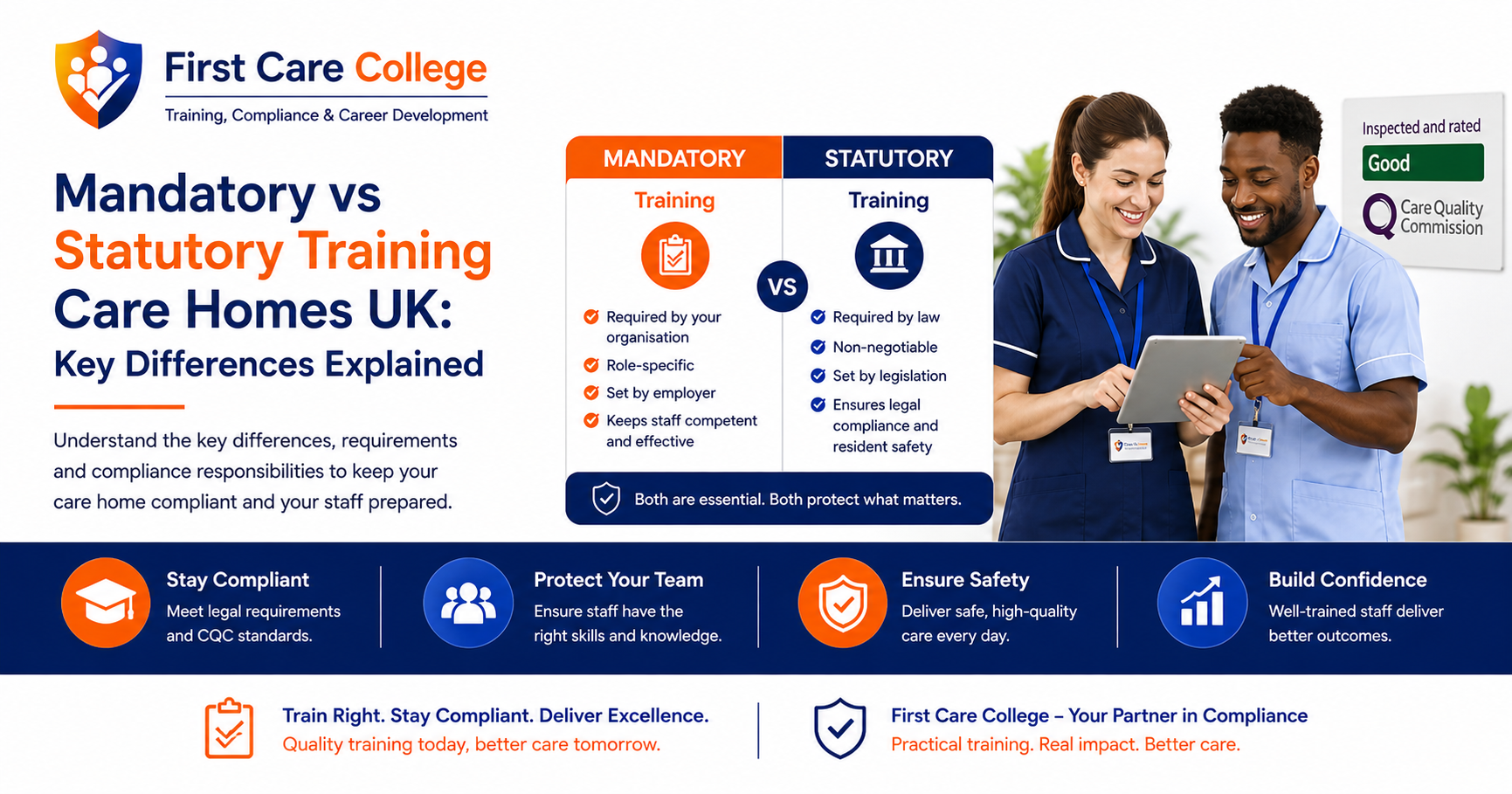
| Feature | Mandatory Training | Statutory Training |
| Definition | Required by your organisation internally | Required by UK law or statutory regulation |
| Legal Requirement | No direct legal obligation | Yes, backed by specific legislation |
| Purpose | Meets internal quality and policy standards | Meets legal compliance obligations |
| Examples | Dementia awareness, nutrition, communication | Fire safety, safeguarding, moving and handling |
| Who Decides | The employer or care home provider | Government, regulators, legislation |
| Consequence if Missed | Internal policy breach, reputational risk | Legal liability, CQC enforcement action |
Statutory training is your non-negotiable legal floor. Mandatory training for carers in the UK is the professional structure your organisation builds above that floor. Both carry consequences when neglected. Neither is optional in a well-run care home.
If you are still unsure whether your current training meets CQC expectations, this is exactly where First Care College’s structured training programmes can give you complete clarity and confidence.
Which Training Do Care Homes in the UK Need Mandatory or Statutory?
Short answer: you need both. But how you structure and prioritise them is where experienced care managers demonstrate their expertise.
1. Start with a full statutory audit
Map every piece of legislation relevant to your service type. Check delivery records, refresh cycles, and expiry dates. This is your legal foundation and it must be watertight before anything else.
2. Build mandatory training around specific roles
A healthcare assistant supporting residents with complex needs carries a very different risk profile to a domestic assistant. Role-based training mapping prevents both over-training in irrelevant areas and dangerous under-training in critical ones.
3. Let your incident data guide you
If your records show a cluster of falls, manual handling training needs immediate attention. If medication errors are appearing, your mandatory training matrix needs a serious review. Your own incident data is the most honest training needs analysis tool you have access to.
4. Keep CQC inspection expectations central to every decision
Inspectors under the Safe, Effective, Caring, Responsive, and Well-led framework are looking for evidence that your staff are skilled, supported, and continuously developed. A well-documented, consistently delivered training programme is one of the clearest signs of strong leadership.
According to Skills for Care’s workforce data, care homes with strong training cultures have measurably lower staff turnover rates. Lower turnover means more experienced teams, better continuity of care, and stronger inspection outcomes.
Training is not a cost, it is one of the highest-return investments a care home manager can make.
Build a Care Home Training Programme That Meets CQC Requirements
If you cannot clearly separate what is legally required from what your organisation expects, your training system already has gaps.
Many care providers think they are compliant until gaps are clearly pointed out. Missing even one requirement can impact your CQC rating and overall credibility.
First Care College helps you map, deliver, and evidence both mandatory and statutory training, so you’re fully prepared before your next CQC inspection.
Conclusion
The difference between mandatory and statutory training in care homes is not a debate for HR departments or training coordinators alone. It is a distinction that sits at the heart of your legal compliance, your CQC inspection outcomes, and the daily safety of every person living in your care.
Statutory training is what UK law demands of you as an employer without compromise or exception. Mandatory training for carers in the UK is what your professional standards, your residents’ specific needs, and your own organisational policies demand above that legal baseline.
Treat them as identical and you will always carry hidden gaps in your compliance framework. Understand them separately, structure them deliberately, and evidence them rigorously, and you will build something that holds up under the harshest scrutiny.
The care homes that consistently achieve Outstanding and Good CQC ratings are not simply delivering the minimum. They are building environments where training is continuous, purposeful, and genuinely valued by every member of the team.
That is the standard your residents deserve. That is the standard worth building towards.
Ready to Explore First Care College Courses?