If you manage a care home or employ care staff in the UK, the Care Certificate is not optional. It is the foundation of safe, competent, and CQC-compliant care delivery.
Yet despite being introduced over a decade ago, many employers still have gaps in how they implement it, track it, or even fully understand what it covers.
This guide breaks everything down clearly.
Whether you are onboarding your first care worker or reviewing your current training process, by the end of this blog you will know exactly what the Care Certificate requires, who needs it, and how to make sure your team meets every standard.
What Is the Care Certificate?
The Care Certificate was introduced in April 2015 following the Cavendish Review.
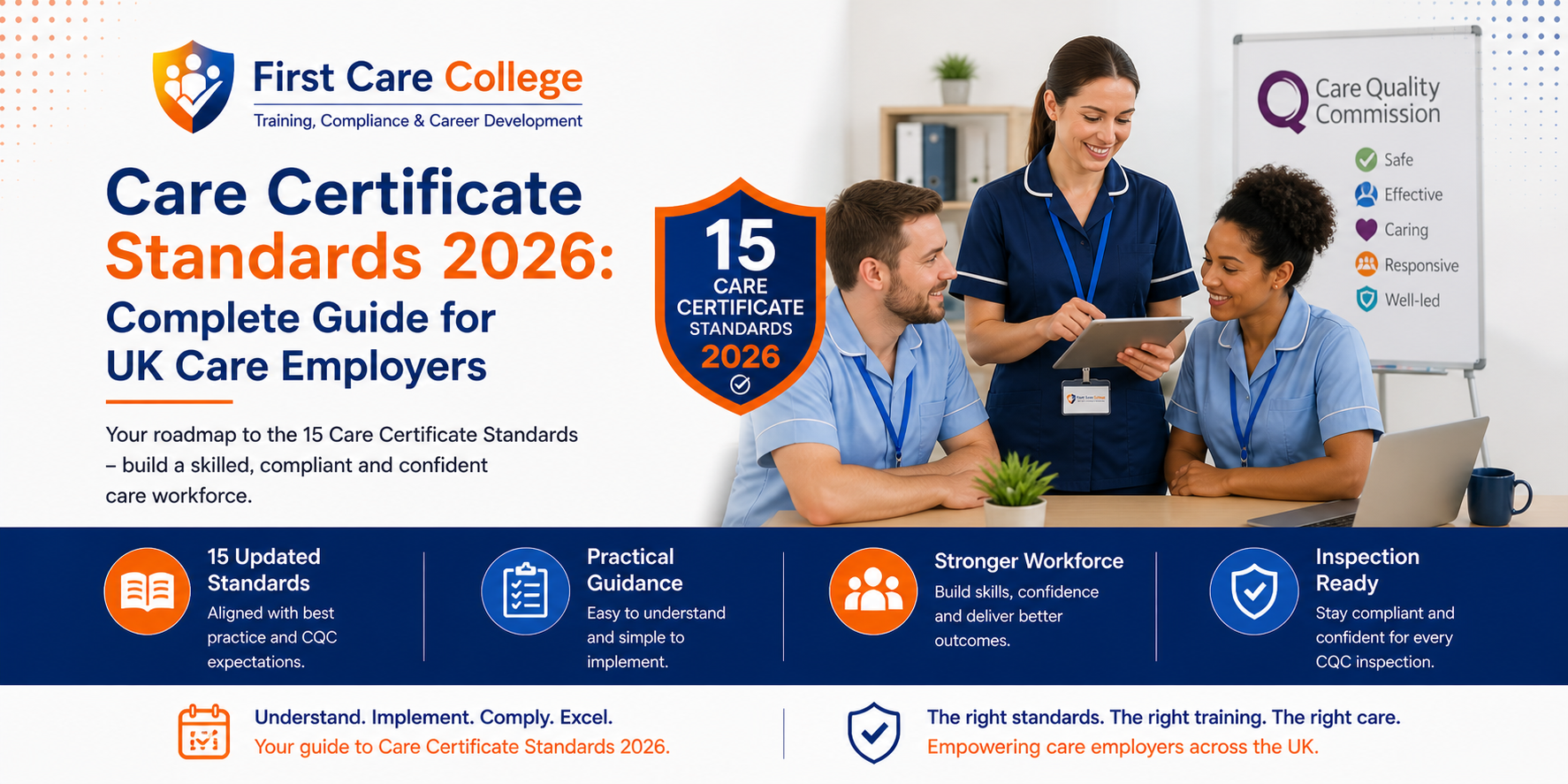
It sets out a clear framework of 15 standards that all new care workers must meet before they can work independently with vulnerable people. It applies across health and social care settings including care homes, domiciliary care, hospitals, and supported living services.
According to Skills for Care, there are approximately 1.635 million jobs in the adult social care sector in England alone. Every single new starter in a direct care role is expected to complete the Care Certificate.
That’s a large workforce to manage and a lot of potential compliance gaps if training isn’t properly tracked.
Who Needs the Care Certificate?
The Care Certificate is required for:
- New healthcare assistants and support workers
- Anyone moving into a care role without prior formal training
- Staff returning to care after a significant career break
It does not need to be repeated if a worker has already completed it with a previous employer, provided it was completed fully and evidence exists.
Important note for employers: You are responsible for ensuring completion. If a CQC inspector visits and your staff cannot evidence their Care Certificate, that is a compliance risk you do not want to take.
The 15 Care Certificate Standards For UK Carers
If your team gets these wrong, it’s exactly what CQC will pick up first. Below is a detailed table covering all 15 standards, what each one covers, and why it matters in day-to-day care delivery.
| Standard | Title | What It Covers | Why It Matters |
| 1 | Understand Your Role | Job responsibilities, accountability, working within boundaries, following policies and procedures | Ensures workers know exactly what is expected of them and do not exceed their scope of practice |
| 2 | Your Personal Development | Reflective practice, supervision, training needs, personal development plans | Supports continuous learning and helps workers grow professionally from day one |
| 3 | Duty of Care | Legal and moral obligation to keep people safe, handling complaints, dilemmas in care | Workers understand they have a responsibility to act in the best interest of the people they support |
| 4 | Equality and Diversity | Protected characteristics under the Equality Act 2010, inclusive practice, challenging discrimination | Promotes dignity and respect for every individual regardless of background, belief, or identity |
| 5 | Work in a Person-Centred Way | Individual needs, preferences, choices, dignity, and independence | This is where average care homes and Outstanding-rated services separate. Workers learn to treat each person as an individual, not a task |
| 6 | Communication | Verbal and non-verbal communication, active listening, communication aids, record keeping | Poor communication is one of the leading causes of care failures. This standard directly reduces risk |
| 7 | Privacy and Dignity | Respecting personal space, confidentiality, upholding dignity during personal care | Builds trust between care workers and the people they support and is a key CQC inspection focus |
| 8 | Fluids and Nutrition | Importance of hydration and nutrition, supporting people to eat and drink, identifying risks | Malnutrition and dehydration are serious risks in care settings. Miss this, and you’ll start seeing weight loss charts, GP escalations, and safeguarding flags. |
| 9 | Awareness of Mental Health, Dementia and Learning Disability | Basic understanding of common conditions, person-centred approaches, reducing stigma | Equips workers to support people with complex needs with confidence and compassion |
| 10 | Safeguarding Adults | Types of abuse, how to recognise and report concerns, whistleblowing, legislation | One of the most critical standards. Every care worker must know how to protect vulnerable adults |
| 11 | Safeguarding Children | Recognising abuse in children, reporting procedures, understanding legislation | Essential even in adult care settings where family members or young carers may be present |
| 12 | Basic Life Support | CPR, recovery position, responding to emergencies, using a defibrillator | Could mean the difference between life and death in a care emergency |
| 13 | Health and Safety | Risk assessments, COSHH, fire safety, lone working, PPE, reporting accidents | Protects both the worker and the people in their care from preventable harm |
| 14 | Handling Information | GDPR, confidentiality, secure record keeping, data protection principles | With increasing digital records in care, this standard is more relevant than ever |
| 15 | Infection Prevention and Control | Hand hygiene, PPE use, waste disposal, outbreak management | Post-pandemic, this standard has taken on even greater importance across all care settings |
If your current training setup cannot clearly track progress across all 15 standards, you are relying on hope, not compliance.
First Care College gives you a structured system to assign, monitor, and evidence every part of the Care Certificate before an inspector ever asks.
How Long Does the Care Certificate Take to Complete?
There is no fixed legal timeframe, but the general industry expectation is that the Care Certificate should be completed within 12 weeks of a new employee starting in their role. Skills for Care recommends this as a guide, and CQC inspectors will take note if staff have been in post for six months with no evidence of completion.
The actual learning hours will vary depending on the individual and the delivery method, but most providers plan for approximately 46 guided learning hours across all 15 standards.
In reality, most care homes struggle here, not because they don’t train, but because they can’t deliver it consistently.
Care Certificate Costs: What to Budget For in 2026
The cost of delivering the Care Certificate varies depending on whether you use in-house assessors, external trainers, or an online platform.
| Delivery Method | Estimated Cost Per Learner | Pros | Cons |
| In-house assessor | £50 to £150 | Familiar with your setting | Requires trained assessor on staff |
| External training provider | £150 to £300 | Expert delivery | Scheduling challenges, high cost |
| Online platform | £20 to £60 | Flexible, scalable, trackable | Needs in-person sign-off for practical elements |
| Blended (online and in-house) | £30 to £80 | Best of both worlds | Requires coordination |
For a care home with regular turnover, the cost savings of online delivery over 12 months can be substantial. A service enrolling 20 new starters per year could save upward of £3,000 annually by switching from external trainer delivery to an accredited online platform.
Online vs Face to Face: What Works for Care Employers in 2026?
For years, classroom delivery was the only option. Gather your new starters, book a trainer, block out two days and hope nobody calls in sick. The problem is that care settings rarely allow for that kind of scheduling. Staffing pressures, shift patterns, and high turnover make block training genuinely difficult to organise consistently.
Online delivery has changed that significantly. A 2023 report by Skills for Care found that 61% of adult social care providers now use e-learning as part of their training delivery. For many care providers, this isn’t about convenience but it’s the only way training actually gets completed consistently.
The most effective model in 2026 combines online learning for knowledge-based content with workplace observation for practical sign-off.
Looking for a training solution that delivers Care Certificate standards online with built-in compliance tracking?
First Care College offers fully accredited Care Certificate training that your staff can complete flexibly, at their own pace, without compromising on quality or CQC compliance.
Explore First Care College courses here!
What CQC Inspectors Actually Look For?
Let’s be honest: this is what inspectors actually focus on when they walk in, and it is rarely spelled out clearly enough.
During inspections, CQC doesn’t just check records. They speak directly to your staff. It’s common for inspectors to ask questions like:
- “What would you do if you suspected abuse?”
- “How did your induction prepare you for this role?”
If your staff hesitate, guess, or give textbook answers without real understanding, it raises immediate concerns.
In one inspection scenario, a care worker had completed all online modules but couldn’t explain safeguarding reporting steps. The result? A competency concern flagged despite full “completion” records.
If gaps are found here, it doesn’t just stay as feedback. It often feeds directly into “Safe” and “Well-led” ratings, and repeated issues can contribute to a Requires Improvement outcome.
How to Deliver the Care Certificate Compliantly in Your Organisation?
Here is a straightforward framework that works for most care settings:
Step 1: Assign the Care Certificate on day one of employment. Do not wait until week two or three. Get the enrollment done immediately.
Step 2: Pair new starters with an experienced colleague or assessor who can observe their practice and sign off competencies.
Step 3: Use a structured online platform to deliver the knowledge-based learning, track progress, and generate completion certificates automatically.
Step 4: Set a 12-week completion target and review progress at 4 and 8 weeks so no one falls behind.
Step 5: Keep records centrally. Whether you use a training management system or a spreadsheet, make sure everything is stored, accessible, and ready to show an inspector at any point.
Step 6: Build the Care Certificate into your wider training matrix so it sits alongside mandatory training like safeguarding, moving and handling, and fire safety.
Most care homes don’t struggle because they ignore training. They struggle because:
- Staff work shifts
- Inductions get delayed
- Assessors aren’t always available
That’s how people end up 4–5 months into a role without completing the Care Certificate which is something CQC notices immediately.
How First Care College Can Help?
This is where having the right training partner makes all the difference.
First Care College gives you a fully structured, inspection-ready training system that lets you onboard staff quickly, track every standard, and confidently evidence compliance when CQC asks.
Whether your staff are completing it remotely or on-site, the courses are built to meet every one of the 15 standards with clear evidence trails that hold up under inspection.
Enroll your staff today and get them Care Certificate ready from day one.
Conclusion
The Care Certificate is not going away. If anything, with CQC’s increasing focus on workforce capability and safe staffing, the expectations around induction training are only going to get tighter.
The 15 standards exist for a reason. They cover the real situations your staff will face on shift, from safeguarding to infection control to basic life support. When your team truly understands and applies that knowledge, the quality of care improves.
That is what this is ultimately about.
Get your delivery right, get your records in order, and make sure every new starter has what they need from day one.
Start your training with First Care College today!