The UK adult social care sector employs over 1.8 million people across England alone.
According to Skills for Care’s 2025 workforce report, staff turnover in care homes still sits at 25 percent annually. That means one in four of your team could leave within the next twelve months.
In one recent inspection, a provider was marked down under Well-led because training records were incomplete across agency staff. The care itself was not criticised, but the lack of clear evidence affected the rating.
Every time someone leaves, a new starter needs proper training from day one. If that training is delayed, inconsistent, or poorly recorded, it quickly becomes a compliance risk.
And when it comes to CQC inspections, training gaps are one of the fastest ways to be marked down.
So when you are choosing between online and classroom care training in the UK, you are not just deciding how staff learn. You are deciding how confident you feel when an inspector asks to see your training records.
This guide gives you a clear and practical breakdown so you can make the right decision for your service.
What Is Online Care Training in the UK?
Online care training allows your staff to complete accredited courses on any device. They can train between shifts, at home, or during quieter periods on the job. Modern platforms are nothing like the dull slideshows care workers used to dread.
Today’s online care training includes video scenarios, interactive assessments, and instant digital certificates. Everything is tracked automatically, so your compliance records are always up to date.
When an inspector asks for records, you either have them instantly or you don’t. That moment matters for your reputation. Here is why thousands of UK care providers have already made the switch.
- Flexibility
Your staff complete training around their shifts without taking time off. There are no fixed dates, no venue bookings, and no last minute cancellations to deal with.
- Cost Savings
You avoid trainer fees, venue hire, travel costs, and expensive staff cover. For smaller providers especially, those savings add up very quickly indeed.
- Instant Certification
Your staff member finishes a module and receives their certificate immediately. No waiting, no chasing, and no gaps in your compliance records.
- Inspection Ready Records
A good online platform shows you exactly who has completed what training. You can pull a full compliance report within minutes of an inspector walking through the door.
If you cannot produce your training matrix within minutes, your current system is already a risk.
For domiciliary care services, lone carers, and teams spread across multiple locations, online training is genuinely transformative. It removes the logistical barriers that used to make consistent training almost impossible.
Many UK care providers now use platforms like First Care College to deliver online training that aligns directly with CQC expectations while keeping records organised and inspection ready.
What Is Classroom Based Care Training?
Classroom training brings your team together in one place with a qualified trainer. It is the method the UK care sector has relied on for decades, and it still holds real value in the right situations.
There are specific areas where hands on, face to face learning is not just better but actually essential.
- Manual Handling
Safe moving and assisting technique must be practised under proper supervision. Watching a video simply does not prepare someone for the real thing.
- Basic Life Support
CPR and AED skills need to be rehearsed on manikins with immediate feedback from a qualified trainer. This is non-negotiable when someone’s life could depend on it.
- Safeguarding Scenario Work
Group discussions around complex safeguarding cases produce insights that no digital module can replicate. Real conversations push deeper thinking and better understanding.
- Team Cohesion
Getting your whole team in a room builds shared understanding and a stronger care culture. That kind of connection genuinely shows in the quality of care delivered.
The honest downside of classroom training is the cost and the logistics. Organising a session for a team with mixed shifts, multiple sites, or high turnover is often more stressful than the training itself.
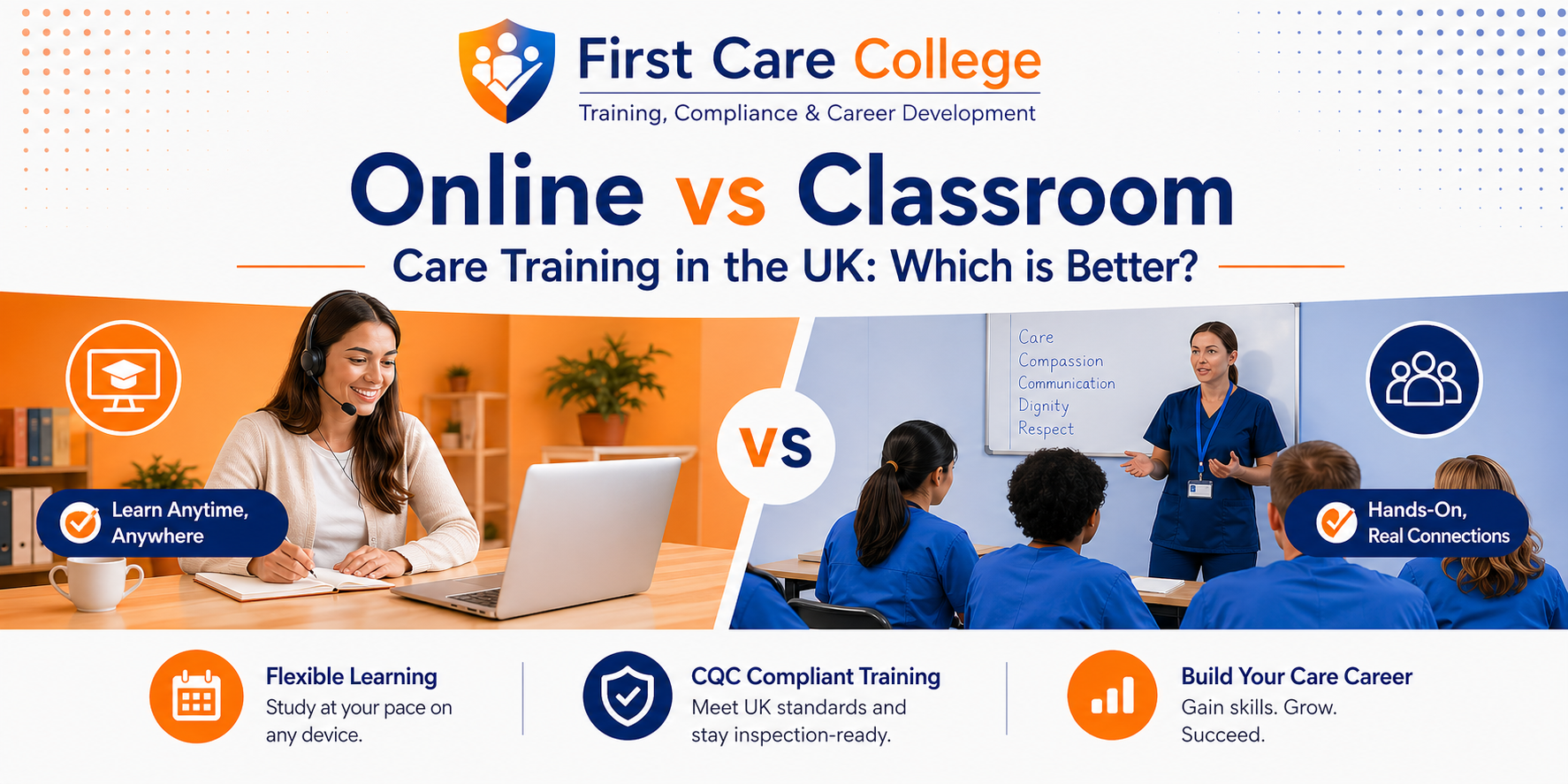
Mandatory Online vs Classroom Care Training in The UK Comparison
Here is the straightforward comparison every UK care manager needs to see.
| Factor | Online Training | Classroom Training |
| Cost | Low | High |
| Flexibility | Very High | Fixed Schedule |
| CQC Compliance | Automated and Instant | Manual Tracking |
| Practical Skills | Not Suitable | Excellent |
| Scalability | Any Team Size | Gets Complex Fast |
| Record Keeping | Digital and Real Time | Paper Based |
| Certificate Speed | Instant | Depends on Provider |
Online training wins on compliance management, flexibility, and cost efficiency. Classroom training remains essential for practical, hands on, and physical skill development. Neither method alone gives you the complete picture.
Which Training Method Is Right for Your Care Service?
In reality, most care managers in the UK are working around staffing gaps and time pressure, not ideal scenarios. So it is very important to choose the right method for completing mandatory training for carers.
If you are also able to choose, let us make this practical:
- You Should Prioritise Online Training If
Your team works varied shifts and cannot all attend the same session. You need to onboard new starters quickly and keep compliance records tidy. Your budget is tight and you need accredited CPD training for carers without high overhead costs.
- You Should Prioritise Classroom Training If
You are covering manual handling, basic life support, or other physical skills. You want to build team coordination and address complex care scenarios together. You have specific competencies that require a qualified assessor to observe directly.
For most UK care providers, the real answer is not one or the other. The providers that stay compliant long term usually combine both and keep tight control over training.
Why Many UK Care Providers Are Switching to Structured Platforms?
The real challenge for most providers is not delivering training. It is keeping it organised, up to date, and easy to prove.
Many services still rely on spreadsheets or manual tracking systems. These often break down under pressure, especially with high staff turnover.
This is where platforms like First Care College make a difference. Their system is built specifically for UK care providers who need to stay compliant without increasing their workload. They provide the best online care training courses in the UK. Here’s why you should choose them:
- Training modules are CPD accredited and aligned with CQC expectations.
- Staff complete courses online and receive certificates immediately.
- Managers can track progress in real time without chasing individuals.
Instead of scattered records, everything is stored in one place and ready when needed.
If your current process would not hold up during an inspection, it is worth reviewing how a structured system could improve your compliance.
Blended Learning: The Approach That Actually Works
The care providers getting training right are not debating online versus classroom anymore. They have simply stopped treating it as a choice between two opposites.
Blended learning combines the efficiency of online theory with the depth of face to face practical sessions. It is widely recognised across the UK care sector as the most effective approach available today.
Your team completes mandatory training for carers online at their own pace. Safeguarding, infection control, fire safety, and COSHH are handled digitally with instant certification.
Practical sessions are reserved for manual handling, basic life support, and observed competency assessments.
All records are tracked in one platform, keeping your compliance portfolio complete and inspection ready.
Take Action Before Your Next Inspection
If your training records are not clear and accessible, it will become visible during inspection.
Now is the time to address that, not after receiving a lower rating.
If your training records would not stand up to a CQC inspection tomorrow, now is the time to fix it. Book a demo with First Care College and see exactly where you stand.
Being prepared is not about doing more work. It is about having the right system in place.
If you still have doubts, you can get in touch with the team directly.
Conclusion
Online care training in the UK delivers the flexibility, cost efficiency, and compliance tracking that modern care services need. Classroom training remains irreplaceable for physical skills and practical competencies.
Together, they form a training programme that is both compliant and genuinely effective.
The real question was never which method is better. It is how to use both intelligently so your team and your residents are properly protected.
Start your training today with First Care College.