In January 2023, a care home in Yorkshire got an Inadequate rating because a CQC inspector found that six staff members were giving out medicine without a valid, up-to-date certification.
The manager had assumed the records were up to date but the training matrix told a completely different story.
That single documentation failure triggered a full enforcement review, a warning notice, and months of regulatory scrutiny the provider is still recovering from.
According to the CQC’s State of Care 2022 to 2023 report, training failures featured in the vast majority of services rated Inadequate or Requires Improvement. Skills for Care data shows that approximately 1 in 5 care workers in England received no formal training in the previous 12 months.
If your training matrix care home UK records cannot answer an inspector’s question in under two minutes, you already have a problem worth fixing today.
What Is a Care Home Training Matrix?
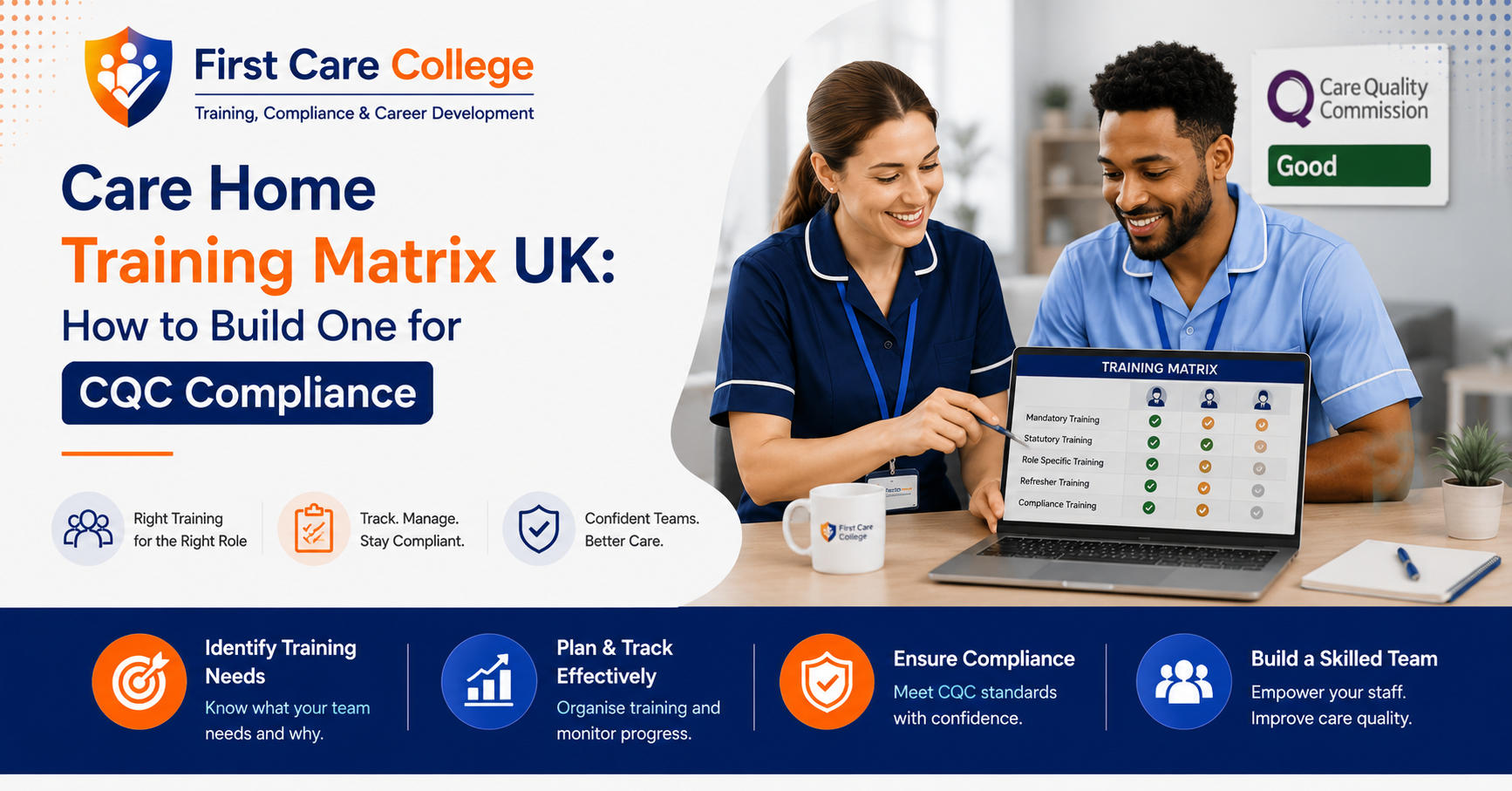
A care home training matrix is a live compliance tracking document that maps every staff member to their required training, completion dates, and renewal deadlines.
It is not a certificate folder. It is not a spreadsheet you open once a year before an inspection arrives.
Think of it like a car service log. You would not drive for three years without checking whether the brakes needed attention. You would not run a care home for twelve months without knowing which staff members have expired safeguarding certifications or overdue manual handling refreshers.
Your training matrix is the system that tells you exactly where you stand at any given moment, before an inspector tells you instead.
How CQC Inspectors Use Your Training Matrix During Inspections?
Under the CQC’s Single Assessment Framework, inspectors gather evidence across Safe, Effective, and Well-led quality statements simultaneously.
Your training matrix directly touches all three, which is why it receives close attention from the moment an inspection begins.
A CQC inspector reviewing a falls incident at a Nottingham care home in 2022 asked to see the training record of the care worker on shift that evening. The manager spent over twenty minutes searching through paper files and email threads, only to produce a certificate that had expired three months earlier.
That moment appeared directly in the inspection report under Well-led as evidence of poor oversight. The home dropped from Good to Requires Improvement on the back of it.
Inspectors are not looking for perfection. They are looking for clear evidence that your leadership team has a functional, consistent system for monitoring staff competency.
Your training matrix is that evidence, and if it cannot be produced quickly and confidently, its absence speaks louder than anything you say in the inspection itself.
What Should a Care Home Training Matrix Include?
A proper staff training matrix care homes UK setup should include:
- Staff names and roles
- Mandatory training courses
- Statutory training requirements
- Completion dates
- Expiry/renewal dates
- Status (completed, due, overdue)
Optional but powerful additions:
- Role-based training mapping
- Colour coding for quick visibility
- Department-level filtering
The key is clarity. If someone external looks at your matrix, they should instantly understand:
- Who is compliant
- Who is not
- What action is needed
Struggling to keep your training records current while managing everything else a care home demands? First Care College helps UK care home managers build CQC-aligned training frameworks that are structured, role-specific, and inspection-ready.
Contact First Care College today.
Step-by-Step Guide to Building a CQC-Compliant Care Home Training Matrix
Building a training matrix that holds up under real inspection scrutiny is not complicated, but it does require a deliberate, structured approach. Rushing it or copying a generic template will leave gaps that only become visible at the worst possible moment.
Step 1: Identify your statutory training obligations
Start with the legal baseline before anything else. The Health and Safety at Work Act 1974, the Manual Handling Operations Regulations 1992, the Regulatory Reform (Fire Safety) Order 2005, and the Care Act 2014 all create specific, legally binding training requirements. List every obligation these frameworks create for your service type before moving to the next step.
Step 2: Define mandatory training based on your actual residents
A care home in Manchester supporting 35 residents with advanced dementia added dysphagia awareness and positive behaviour support to their mandatory training list after a clinical review flagged swallowing risks and rising incidents.
That bespoke mandatory framework directly contributed to a Good rating at their next inspection. Your mandatory training for carers in the UK must reflect your actual residents, not a template built for someone else’s service.
Step 3: Map every training requirement to specific roles
A healthcare assistant working nights with complex needs residents carries a completely different risk profile to a kitchen assistant or maintenance operative.
Role-based mapping prevents dangerous under-training in direct care roles and removes irrelevant courses from staff for whom they carry no practical application.
Step 4: Set legally informed refresh cycles for every course
Refresh cycles are not suggestions. They are compliance deadlines, and missing them creates the same liability as never completing the training at all. As a standard guide for most UK care settings:
- Basic life support refreshed annually
- Manual handling refreshed annually or biannually
- Safeguarding adults at higher levels every two to three years
- Fire safety awareness annually
- Medication administration annually with competency reassessment
Always verify refresh requirements against the specific legislative guidance for each course, as requirements do evolve.
Step 5: Choose a tracking system with genuine visibility
A well-maintained spreadsheet can work effectively if it is set up to flag expiry dates at thirty, sixty, and ninety day intervals. A care home in Bristol switched from paper files to a colour-coded digital matrix in 2021 and identified fourteen overdue training renewals within the first week of setup.
Those gaps had been invisible in their previous system for over a year. Whatever system you choose, it must surface problems before they become inspection findings.
Step 6: Assign named accountability and review monthly
If everyone owns the training matrix, nobody owns it. A named person in your management team must carry specific responsibility for keeping it current, escalating gaps, and presenting training compliance as a standing agenda item in management meetings.
This single step is what separates care homes that maintain compliance consistently from those that scramble before every inspection.
Common Training Matrix Mistakes That Appear in CQC Inspection Reports
Many care home managers put genuine effort into building a training matrix and still find it flagged during inspection. The reason is almost always one of the same recurring mistakes seen across the sector.
The common mistakes include the following:
- Using a generic template without adapting it to your service is the most widespread problem. A downloaded template is a starting point, never a finished compliance document.
- Failing to update records in real time creates evidence gaps that inspectors interpret as non-compliance even when the training actually happened.
- Allowing renewal dates to pass without a tracking system means statutory training lapses quietly, invisibly, until an inspector surfaces it.
- Adding new starters to the rota without adding them to the training matrix is one of the most common gaps in high-turnover services, and one of the least forgivable in the eyes of an inspector.
Real case: A CQC inspector in Birmingham noted in a 2022 report that a provider’s training matrix listed identical courses for kitchen staff and senior care workers with no role-based distinction whatsoever, contributing directly to an Ineffective evidence judgement under Well-led.
Build a Training System That Actually Holds Up in Inspection
If your current setup feels unclear, inconsistent, or difficult to maintain, that’s your warning sign.
Many care providers believe they are compliant until inspection highlights the gaps.
First Care College helps you:
- Map mandatory and statutory training properly
- Track completion across all staff
- Keep records organised and inspection-ready
Instead of reacting to problems, you stay ahead of them.
If you want a training system that actually works in real care environments, this is where you fix it.
Conclusion
A training matrix care home UK managers can genuinely rely on is not a document you create once and revisit annually. It is a live system, maintained consistently, reviewed regularly, and built precisely around your specific residents, roles, and legal obligations.
The care homes achieving and sustaining strong CQC ratings are not operating on goodwill or good intentions. They are operating on evidence, and their training matrix is central to that evidence.
Build yours properly, keep it current, and let it do the compliance work it was designed to do.
Explore First Care College Courses Now!